This past week I worked on a pattern I picked up at the last sale at Hancock's,
Vogue 8670. I thought, here is a quick shirt that I can zip together really quickly, and I will be nice for this fall. Oh, how wrong I was....

I picked up a length of green knit from the bargain table to put together a quick muslin. Interestingly, almost the same shade as the one in the illustration. The pattern looked promising, there were bust darts which were a nice touch. I could live without the buttons at the shoulder...does it remind anyone else of a baby's onesie?
Anyway, I set off on my muslin, and based on my measurements I cut a size 20 at the bust, morphing out to 22 at the hips. Here is the finished shirt:

The first issue is immediately apparent, the neck. According to the drawing, it is supposed to fit similarly to a turtleneck. But that is not what I ended up with. The pattern describes it as a "scrunch turtleneck collar," and the illustration shows a much closer fit:

However, there are a couple of indications that the collar was never going to look like that. For one, the "turtleneck" collar piece is just a giant rectangle. However, for the turtleneck to fit like the drawing, the pattern piece would have to be contoured in some way. For example, in the recent (September) Burda magazine there was a turtleneck pattern, and according to the line drawing, there is a clear contour to the turtleneck...almost like an hourglass shape:

Also, in the vogue top, the turtleneck collar is sewn directly onto the same neck countour that is used for the crew neck:

So as a result, you end up not with a turtleneck, but with a little bitty cowl:

Which, is not exactly a bad thing. I have other shirts in my closet with similar collars. But one remaining issue is that it is HUGE:

Just look at that mess! Why am I smiling?? And it is just as bad from the back. Look how much extra room is at the hips:

And darts or no, it is utterly shapeless. So, back to the drawing board. I decided that it needed a couple of things, a center back seam for contouring, overall shortening, more contouring at the side seams, and a smaller size overall.
Because I am inherently lazy....I decided to use a pattern that I was already satisfied with and use it as a template to redraft the body of the shirt. I decided to use
New Look 6735, a pattern that had been selected a "Best Pattern of 2008" at Pattern Review.
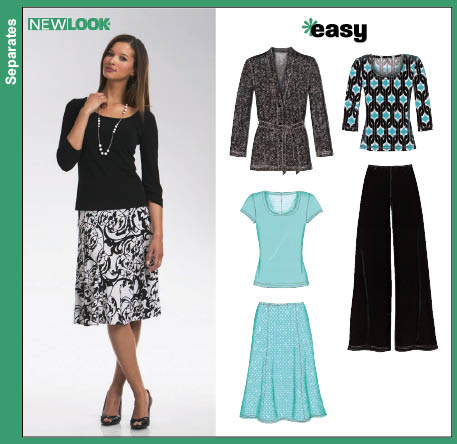
The pattern consists of a close-fitting tee, a skirt, pants, and cardigan. The tee also has the advantage of a center-back seam:

I had made the tee before and was very happy with the outcome so I set out on morphing together two patterns. I used the sleeves and neckline from the Vogue pattern and the body of the shirt from New Look. Morphing together a shirt with raglan sleeves (Vogue) and set in sleeves (New Look) does present a challenge, so as I was tracing, I aligned the pattern using the top of the side seam (armpit) as a marker.
I also ended up going down from a 20 to a 16 in the Vogue top, grading out to what was an 18 at the hips for the New Look top, as opposed to grading out to a 22 as I had in the Vogue muslin. I also cut the sleeves and neckline in the Vogue top down to a 16. I also shortened the pattern significantly. I had some knit left over from my
Butterick 5522 dress and my
BurdaStyle 08.2010.140 dress, so decided to make a bi-color version:

Here is the final verison:

The center back seam allows for a much-needed contour:

For the crew neck, I just cut a strip of fabric on the cross-grain (with the stretch), folded it over, and stretched it as I sewed it, just like I normally do collar bands:

But of course, the proof is how it fits, not how it fits my butt-less dress form:

Some of the differences in the new pattern includes a lack of bust darts, but the New Look pattern accomodates some extra space for the bust by making the front pattern piece longer than the back, and that extra length is eased in during sewing. The contoured waist makes a HUGE difference, as well, and the shorter length is a vast improvement.
So, what was initially a quick, easy pattern turned out to be a two-week-long odyssey but ultimately yielded good results.
 So...I can't really comment on whether or not the instructions were any good, because I just muddled through and put it together however. It somewhat resembles a dress, so I must have been close!


